
You Can't Make Me Vibecode
On the historical parallels between vibecoding and open source

History doesn’t repeat itself, but it sure does rhyme.
I’ve been thinking recently about an old Neal Stephenson essay, In the Beginning… Was the Command Line. The essay was published in book-length format in 1999, at a time when Linux felt like the future. The book is about operating systems, but it’s also about much more than that. Fundamentally, it’s about the sort of relationship people have with their computers.
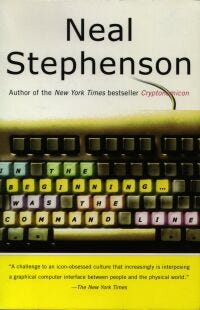
There’s this great, overarching metaphor that sticks with you — that Microsoft Windows is like a station wagon, and Apple’s OS is like a luxury sedan, while Linux is like a free tank. Linux is the much better, much cheaper alternative. People find it intimidating, because they don’t know how to repair a tank. But it isn’t like they know how to repair a station wagon or a sedan either!
I first read the book in the late ‘00s, and it left me thinking “well, I’m convinced! I should probably learn Linux. Eventually, everyone is going to be using the much cheaper/much better operating system. And then, of course, I did no such thing. Learning to code has always seemed like a chore to me. I never developed the taste for it. And so I just never put in the effort, forever satisfied with Apple’s expensive luxury sedan model. The type of relationship that Linux-users have to their computers is not the sort of relationship I wish to have.
I read the book again last year. The argument is still compelling. But the interesting bit, with hindsight, is that the seemingly inevitable future-of-mass-computing, as rendered by Neal Stephenson never came to pass.
Linux (and open source software more generally) was a revolution. But it was only a revolution within the boundaries of the computer industry. Much of the web runs on open source. The core of Apple’s operating system runs on open source too. You interact with open source software throughout your day. But (if you’re a normie like me) your relationship to open source software is no different than your relationship to proprietary software.
So the Linux revolution didn’t fail, but it also didn’t follow the expected path. The early adopters in 1999 were all, by definition, techies. They saw the liberatory potential of this new software system and imagined it would transform the public, altering how people en masse engaged with software. But the public remained stubbornly un-transformed. Linux empowers the computer user, but a great many users simply were not interested in that sort of empowerment.
This has all been on my mind recently because of Claude Code and the brash confidence I am hearing from some corners of the internet about the shape of the AI revolution.
I haven’t tried out Claude Code yet. I’ve been meaning to. I just can’t think of anything that is worth the hassle. I read Casey Newton’s piece on the subject, where he had Claude Code build him a website. I watched the Hard Fork video where he walked Kevin Roose through the process too. It’s interesting, and I think it’s worth taking seriously.
But the thing is, I don’t need a new website. I don’t need a digital assistant to prep my course lectures or keep track of my expenses. Maybe that makes me an outlier, but I kind of doubt it? My daily routines are extremely boring-middle-aged-dad-coded.
Take a look at this Super Bowl ad, from Base44. It isn’t the best AI ad of this year’s crop (that would be Anthropic, being so deliciously petty). It wasn’t the worst (that would be Svedka. What? Why?). But it’s probably the most in sync with the current mood among AI boosters.
It’s a simple ad. An office worker vibecodes an app. Her colleagues are incredulous. (She can’t do that! She doesn’t know how to code!) But ah hah, now with Base44’s AI, she can. So then all the other office workers start vibecoding their own apps.
I brought this up with my students on Monday. Do any of them have ideas for apps they would like to vibecode? At first, no one raised their hand. Then one student volunteered that she liked the idea of creating an app that could visualize and organize her closet. She referenced a scene from the 1995 movie Clueless.1 But the student then immediately backtracked. She didn’t want to vibecode the Clueless closet-organizer app. She just wishes she could download something like that. The type of relationship that those imaginary office-workers had to software was not something that I or my students wish to have.
This doesn’t render Claude Code or agentic coding agents just a flash in the pan. As I mentioned last month, I think it’s worth operating from the premise that we are seeing a step-change in what these tools can be used for. But it does mean we should keep in mind that the experience of early adopters — the people who are most enthused by coding agents — is probably dissimilar to the normies. This thing can be revolutionary for coders and entrepreneurs, while still being nothing like the social revolution they imagine is in the offing. It feels very much like Neal Stephenson overestimating the social contagion of the Linux revolution circa 1999. It can be a lightning bolt within one sector of the economy, but still limited to people with a very specific set of tastes and preferences.
Incidentally, I just finished reading Clive Thompson’s 2019 book, Coders: The Making of a New Tribe and the Remaking of the World. It’s quite a good book, and well worth checking out. The final chapter is a real eyebrow-raiser at this juncture. The chapter — “Blue Collar Coding” — is about how the demand for skilled coders is so great, and the market for coding jobs is so promising, that we are heading for a future where more and more people make their careers out of learning to code.
That was the future, circa 2019. (Or, at least, it was a claim that had the aura of futurity to it.) Major resource investments were made, for YEARS, premised upon the belief that the future would both demand and reward people with a coder’s sensibilities and skills. The developments in agentic coding are indeed a radical challenge to the people and programs who were tied up in those claims for the past decade or so. This is a big deal for them. But there is a layer of insulation between those circles and mass society.
Linux didn’t conquer the world, because Linux demanded a relationship to software that most people didn’t want to have. I continue to pay arguably-too-much for my Macbook because I want to have a certain type of relationship to computing. Coding is not something I want to do. Linux did partially did conquer the software world, though. And Claude Code might conquer the software world as well. But the trajectory is probably going to abruptly slow down, because its creators don’t recognize the gap.
The promise of vibecoding is that now you can code without learning to code. And I suspect a meaningful part of what comes next is that the people who did not want to have a coder’s relationship with computing simply won’t get into vibecoding.
Think of Claude Code as a tool for empowerment. But many people aren’t asking for empowerment, at least within the boundaries of their relationship to a computer. What they want instead is convenience.
(And, of course, all this is happening against the backdrop of eye-watering expenditures. Agentic coding needs to be a revolution for the masses, or else the finances don’t work out. But that’s a story for another day.)
Sidenote: apparently the youngs have seen Clueless? I remain baffled. What a random piece of mass culture from my youth for them to be familiar with.
As a software developer who generally thinks vibecoding still isn't worth it, the real test will be can it transform *Scientist* code. Scientists need to code a lot, are generally bad at it, but also care a *lot* about precision and accuracy in a way vibecoding works against. A model that overall improves the quality of scientist code can actually do a lot of good.
I can think of some obvious apps to vibecode. How about one that takes a list of my friends, looks up what they've posted on Facebook for the last 30 days and gives me a reverse chronological list of their posts? How about one that does a Google search and eliminates the advertisements, the web sites that are full of fatuous, probably AI generated, textual padding and shows me the remaining hits? How about one that gives me the list of Netflix offerings in a particular genre showing the teaser panel and the full descriptive text for each? How about one for Amazon that lets me search for vendors but ignore results offering products that I didn't search for and places close textual matches, like those matching the name of a book and its author, at the top?
I'm sure there's a felony contempt of business model here to prevent this kind of app from getting written, but AI might make it easier to disenshittificate the internet.